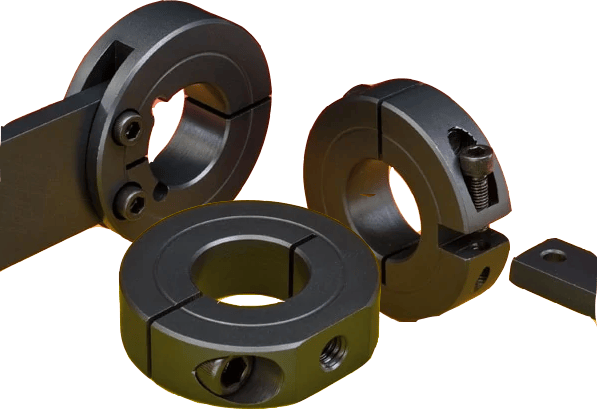
A full line of customizable flange shaft collars that incorporate an integral clamp, maintain their perpendicularity, and are easy to adjust has been introduced by Stafford Manufacturing Corp. of Wilmington, MA.
A broad line of mechanical components for use as stops, spacers, shaft connectors, and versatile mounting devices in warehouse automation systems has been introduced by Stafford Manufacturing Corp. of Wilmington, MA.
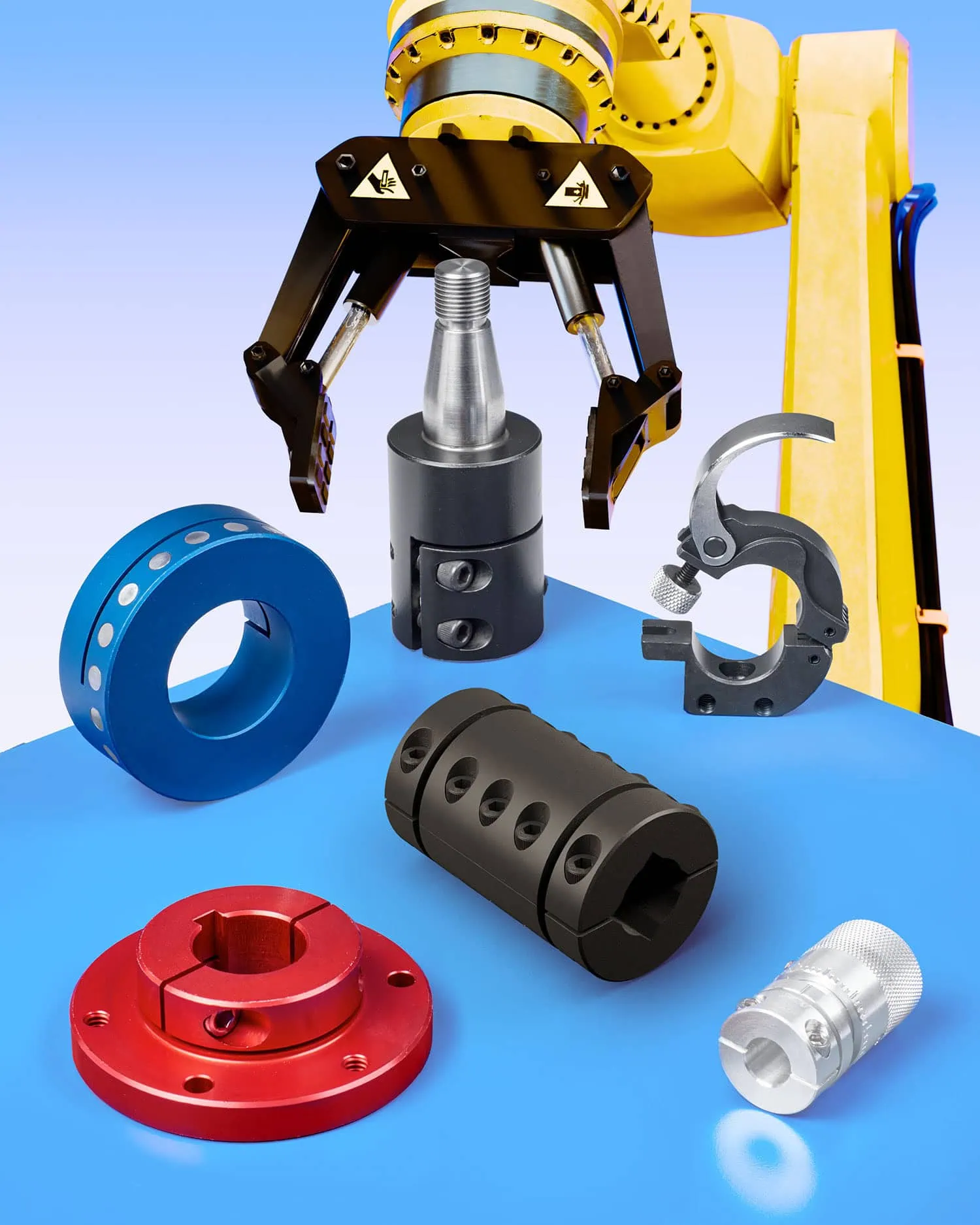
A wide range of standard and custom shaft collars, couplings, and mounting devices that are suited for use in robotic systems and equipment have been introduced by Stafford Manufacturing Corp. of Wilmington, MA.
Selecting a shaft collar for your rotating machinery is about more than just the right fit; the proper collar will enhance the performance and longevity of your equipment. With the wide variety of shaft collars on the market, each with its own unique features, benefits, and applications, it’s important to understand what sets them apart.
In this guide, we’ll help you gain an understanding of the differences between set screw, one-piece, two-piece, and hinge shaft collars, focusing on aspects like axial holding power, price, installation, accessibility, and maintenance requirements.
Mountable shaft collars are used in many food processing, conveying, and heavy equipment applications. They attach to shafts, rods, pipes, tubes, or cylinders to position and secure components, help align moving parts, and guide or restrict movement within assemblies.
Mountable shaft collars fit around shafts of different diameters and shapes including round, threaded, hexagonal, and square. Collars are secured to shafts with clamp screws and come in hinged and one- or two-piece configurations. They can also be mounted to plates, brackets, bearings, or equipment to secure the collar as part of an assembly. Collars can be made of a variety of materials including steel, stainless steels, aluminum, and plastic. All of these options make them versatile for applications including power transmission and motor components, gear assemblies, bearings, and more.
Here, we’ll look at different types of shaft collars, how they work, and several options for customization.
Selecting the Best Type of Mountable Shaft Collar for Your Application
Mountable shaft collars come in a range of materials, bore sizes and shapes, and mounting options to meet the requirements of many applications.
Most mounting collars are secured around a shaft, cylinder, pipe, or tube with a clamp screw located on the outer diameter of the collar. The clamp screw provides excellent holding power against axial rotation and does not damage the shaft, which can be a risk with set screw collars.
Collars can be used on a shaft alone, mounted to a flat surface, stacked or mounted to other collars, or welded to other components.
Three of the most common configurations are described below:
Drilled/Threaded Face Holes: These collars feature two tapped and threaded mounting holes through the face of the collar to ensure a secure interface between components like plates, pulleys, bearings, or sprockets. They are easily mounted, allowing flexibility for a variety of applications.
Outer Diameter (OD) Flats and Holes: These feature flattened portions at the top and bottom of the outer diameter of the collar. Vertical tapped holes are centered in each flat portion and can be used with different types of screws to secure the collar around a shaft, cylinder, or pipe, or to stop it from moving. These collars can be used in traditional shaft mounting applications for guiding, positioning, or stopping rotation of a shaft, and they can be mounted to each other, to a base plate, or welded to components.
Quick Clamping/Quick Adjust: These standard mountable shaft collars have the additional advantage of a quick adjust mechanism. They are a good choice for applications that require frequent tension adjustments or repositioning of tools, fixtures, and equipment without the hassle of finding the correct wrench or other tool.
Our Mountable Shaft Collars
Stafford Manufacturing offers a full line of mountable shaft collars to suit every application. Collar design, material, and finishing choices can be customized to meet your specific requirements.
Our full product line includes round, threaded, square, and hex bore collars; rigid shaft couplings to connect two shafts and transfer rotary motion; flanged or other collar designs; remachinable collars and couplings; and tools and accessories for retrofitting and maintenance.
Our mountable shaft collar options include the following:
Stafford Manufacturing has over four decades of experience in Mounting Shaft Collar manufacturing. We carry over 4,000 standard products, with many in stock for same-day shipping. Our Solution Series of products includes more than 1,000 specialty mechanical products you won’t find from any other manufacturer.
Our team also has the expertise to create custom collars, with end-to-end support including in-house CAD design and engineering. Facility certifications include ASA, ASME, ANSI B18.3, ISO 9001:2015, REACH, and RoHS.
Contact Our Experts for Premium Shaft Mounting Collar Solutions
Stafford Manufacturing leads the industry in quality, service, selection, and value. Please contact us or request a quote to discuss your shaft mounting collar application.
Few mechanical components are as versatile and widely used as shaft collars. These seemingly simple devices are vital across a multitude of applications and industries, ensuring the smooth operation of machinery, enhancing safety, and contributing to precision in numerous applications. Let’s take a closer look at common collar shaft uses and explore their significance in different sectors.
Common Uses for Shaft Collars
Shaft collars are specialized one- or two-piece components that fit over a shaft, rod, tube, cylinder, or pipe. A clamp screw on the outer diameter of the collar provides radial holding power to prevent the collar from moving out of position. For certain applications, some shaft collar varieties allow for quick adjustment during operation. Collars can be used individually, mounted to a flat surface, stacked with or mounted to additional collars, or welded to other components.
These indispensable devices ensure the stability, control, and safety of mechanical systems across many different applications, such as:
Shaft positioning: Shaft collars restrict radial and axial movement to ensure mechanical integrity in equipment.
Bearing retention: Shaft collars eliminate axial creep so bearings and other rotating parts stay properly aligned.
Sprocket or pulley mounting: Shaft collars secure rotating components to maintain their placement and aid torque transfer.
Shaft identification: Collars can be used as visual markers to quickly distinguish shafts from each other or as reference points for adjustments, measurements, or maintenance.
Clamping and locking: Shaft collars can secure handles, levers, or knobs that are subject to vibration or operational stress.
Safety stop devices: Shaft collars limit the range of motion of machinery parts to stay within safe operating parameters, including gradual movement due to vibration or heavy use.
Axial force distribution: Shaft collars act as thrust bearings and distribute axial forces to reduce wear on bearings, shafts, and other components exposed to axial loads.
Spacer devices or spacer positioning: Shaft collars can serve as spacers, maintaining precise distances between components.
Industry-Specific Applications
Shaft collars are beneficial for many types of machinery and mechanical systems that are commonly used in different industries. The following are some of the many industries that use equipment containing shaft collars:
Manufacturing and Robotics: Shaft collars are used in various types of manufacturing and robotics equipment, including conveyor systems, robotic arms, and CNC machines.
Heavy Machinery & Aerospace. Shaft collars help to align and guide the proper movement of shaft components in engines, aircraft control systems, and drivetrain assemblies.
Agricultural Machinery: Shaft collars enhance efficiency and safe operation in irrigation systems, tractors, harvesters, and other heavy farm machinery.
Other Industries: Shaft collars are also heavily used in the mining, military and defense, food and beverage, laboratory/research, marine, medical, oil and gas, optical, power transmission, and retail industries.
Stafford, Your Trusted Shaft Collar Manufacturer
With over five decades of experience, Stafford Manufacturing is a leader among shaft collar manufacturers and distributors. We provide standard and custom collars to fit every need with options for design, material, and finishing. Bore holes are available in many sizes in round, threaded, square, and hex shapes. We also supply rigid shaft couplings and flanged or other collar designs.
Our custom manufacturing capabilities include CAD design and engineering based on your requirements. Shaft collar assemblies and component parts meet ASA/ASME/ANSI B18.3, RoHS, and REACH standards and we are ISO: 9001:2015 certified.
Contact us or request a quote today to discuss how we can support your projects with quality shaft collar solutions.
Shaft collars attach to shafts and other pieces of hardware to affix components in place. They can grip bearings in the right position, act as mechanical stops to halt rotary motion along the shaft, and ensure internal components don’t shift into misalignment. Because these components are so versatile, they come in a wide range of options for different industrial and commercial applications.
At Stafford, our experienced team of engineers specializes in creating sturdy, high-performance shaft collars for virtually any configuration. Learn more about the six most common types of shaft collars and their role in food processing, conveyance systems, and heavy-duty machinery.
Types of Shaft Collars
Depending on your machinery setup and your mounting needs, there are multiple different shaft collars available. These different varieties are classified based on how accessible the shaft is and the axial hold required. Clamp shaft collars, for example, clamp onto the shaft instead of requiring a set-screw for attaching to the shaft. Some of the most popular options include balanced, hinged, set screw, single split, double split, and threaded shaft collars. Take a deeper look at the different options:
Set Screw Shaft Collars: This collar is solid. It doesn’t have any relief cuts, and it doesn’t split into different sections. Instead, the set screw shaft collar is put into position and then affixed to the shaft by a tightened set screw that runs from the outer to the inner diameter of the collar.
Single Split Shaft Collars: This type of collar has one slot opening that allows for sliding the collar onto the shaft and then clamping it down. The slot can be opened and closed with a hex screw. The advantage of this model is that it’s easy to install, however, it doesn’t have the same uniform gripping strength as two-piece clamping collars and cannot be used where the shaft end is inaccessible.
Double Split Shaft Collars: These two-piece collars have two halves that are joined together by two socket cap screws. This allows for easy installation, as they can be installed either axially or radially. They also have a more uniform distribution of holding power than one-piece split collars.
Threaded Shaft Collars: These collars have an internally threaded clamp so they can be installed over a matching threaded shaft. Not only do the threads ensure the placement is exactly right, but the shaft is designed for supporting heavy axial loads. Threaded shaft collars are available in both single-split and double-split varieties.
Balanced Collars: Balanced collars are built to reduce vibration and shaking on a spinning shaft. They also help ensure an even distribution of the load weight. They feature a design similar to a double-split shaft collar, but the attaching screws sit opposite each other to provide even distribution.
Hinged Collars: Hinged collars have a triple-link hinge and a captive clamping mechanism. This allows the collar to open easily, be positioned and then clamped shut. As a self-contained unit, there is never a risk of loose screws.
Each of these shaft collars can play a critical role in the integrity of your equipment or facility systems.
Food Processing
In food processing systems, shaft collars can help at every stage of production and packaging. Shaft collars can help ensure consistent spacing between moving and weight-bearing elements, including supporting weight-bearing components and ensuring gears stay in the correct alignment during operation. Some key applications include:
Guiding and stopping parts
Mounting, aligning, and spacing components
At Stafford Manufacturing, we construct all of our shaft collars with a smooth, burr-free finish that mitigates the risk of buildup and bacteria. Our collars are available in several types of stainless steel, making them ideal for situations requiring corrosion resistance or the ability to withstand frequent washdowns.
Affordable Cost
Wide Variety of Materials
Mounting Capabilities
Variety of Styles to Suit your Needs
Alignment Capabilities
Easy Assembly
Conveying
Shaft collars are common in conveyor systems because they ensure all of the moving parts stay in alignment and can handle the weight of different loads. One common application of shaft collars in conveying is to keep the rollers consistently placed and aligned. Shaft collars from Stafford are built with sturdy, long-lasting materials that comply with today’s construction and industrial regulations.
Heavy-Duty Machinery
Heavy-duty machinery, like cranes and bulk industrial equipment, needs large, heavy-duty shaft collars that can ensure adequate weight-bearing capabilities. Collars from Stafford are built to secure shafts and axles, support weight, and stop movement as needed for smooth system operation.
Learn More About Shaft Collars From Stafford
The team at Stafford Manufacturing is here to help provide the right shaft collars for any application, from food processing centers that need to tightly control the risk of contamination to paper and pulp facilities that manage heavy loads.Contact us today to learn more orrequest a quote to start your order.
Stafford Manufacturing Corp. designs and manufactures rigid couplings, shaft collars, and specialty mechanical parts used in automation, power transmission, motion control, and other OEM and MRO applications. We have collars and couplings available in square, threaded, hexagonal, keyed, and round bore configurations. In addition, we can add drive slots, press-fits, pulleys, or other special parts to meet your needs.
Here you’ll learn about each of these bore options and how to decide on the ideal shaft collar or coupling for your application.
Types of Collar and Coupling Bore Configurations
Shaft collars and rigid couplings are machine components that slide over a shaft and lock into place with either set-screws or with clamping screws. They have three primary functions:
Holding components in place
Creating a connection between a shaft and another component
Positioning or locating parts along a shaft
Manufacturers supply variations of collars and couplings in different sizes, designs, and materials to fit a wide range of applications. Some of the common shaft collar bore configurations include:
Round
Threaded
Square
Hex
Keyed
Round Bores
As one of the most popular bore configurations, round shaft collars and couplings are used in various power transmission, motion control, and mounting applications. Serving as locators, spacers, bearing faces, or stops, they are most often used on shafts, tubing, pipes, and split hubs.
Round bore configurations are found in the following products:
Threaded shaft collars have a threaded interior that matches with certain threaded shafts. These provide superior grip, suitable for uses that require precise preload and location settings. Threaded shaft collars act as a stop to position parts or prevent them from moving along the shaft.
Threaded bore configurations are found in the following products:
Stafford Manufacturing produces hexagonal and square shaft collars and couplings to fit onto hexagonal and square-shaped shafts. Square and hex shaft couplings and collars are easy to install and customize with mounting capabilities if necessary. They provide high clamping power and are primarily used in food processing and conveyor systems.
Shaft couplings can be configured with keyways, but they are not always required. They should be utilized for couplings designed to support radial alignment and loads with high torque. Determine whether radial alignment or additional torque will affect the system’s overall operation, and then use that analysis to decide whether you need a keyway.
Selecting Your Shaft Collar or Coupling Configuration
The right shaft collar or coupling is the one that fits your configuration and application. In some cases, a certain type of configuration may be better than other options (i.e. square, hex, and keyed shafts can handle more torque). Keyed shafts in particular have a locking position that makes accommodating higher torques possible.
Standard bores are cost-effective options that fit most basic applications. Stafford Manufacturing carries round, threaded, square, hex, and keyed bores as standard products, so our customers can rely on us to have what they need, when they need it. In addition, Stafford is the only stocking manufacturer of a full line of square and hex bore products.
While standard bore products serve most applications at the lowest cost, some applications require customized collars or coupling bores. Stafford has been manufacturing custom shaft collars and couplings for over 47 years and we can produce to your exact needs at a fair price with no minimum order quantity.
Stafford Is Your Custom Shaft Collar and Coupling Manufacturer
Stafford Manufacturing has nearly 50 years of industry experience. As an ISO 9001:2015-certified business, our staff has the quality control standards in place to produce the highest quality shaft collars and rigid couplings. We have a large selection of products, which enables us to assist you in selecting the ideal bore configuration for your particular needs and price range. If you can’t find a shaft collar or coupling that meets your needs, we will collaborate closely with you to design and produce a custom solution.
A shaft collar is a simply-designed machine component composed of a plastic or metal ring fitted around a rod to act as stops, spacers, or for mounting components. The collar can be loosened or tightened around the shaft using a clamp screw or multiple screws. They are used for tasks ranging from bearing loads to holding components in place along a rod. Among the many types of shaft collars are threaded shaft collars, which offer unique features that make them suitable for various applications.
What Is a Threaded Shaft Collar?
A threaded shaft collar is a type of shaft collar defined by the threaded
pattern on the inside of the ID. While the standard shaft collar has a smooth interior, threaded shaft collars employ this textured interior to provide superior grip to the rod it is attached to.
Threaded shaft collars are paired with a threaded rod, making them fasten together much more securely than a smooth shaft collar on a smooth rod. This provides higher axial holding power with less chance of damaging the rod. Additionally, threaded shaft collars allow for precise positioning and easier adjustments along the rod’s length.
In terms of variants, threaded shaft collars are typically manufactured in two distinct styles. The one-piece clamp collars are designed as a singular piece of equipment, which are fastened by being pressed together and then tightened once in position. Two-piece split collars consist of two separate halves of a single collar held together by a pair of screws that can be used to loosen and tighten the ring. Threaded shaft collars are typically made from steel or hard plastics. HInged threaded collars are also available for a simple, all-in-one assembly style.
Applications of Threaded Shaft Collars
Due to the various advantages threaded shaft collars have over smooth
shaft collars, they are typically used in applications where additional precision or strength are required. In machinery, threaded shaft collars are most frequently used for load-bearing applications and as spring tensioners. Their holding power and durability allow them to survive longer when placed under high stress than other similar parts. They are also used as end stop positioners and as limiters in repetitive operations.
Hospitals and other medical facilities make use of threaded shaft collars in places ranging from surgical equipment to beds and equipment stands. Other applications include:
Automation machinery
Mechanical stops
Locating components
Sprocket hubs
Bearing holders
Shaft protectors
Measuring and testing equipment
Stafford Manufacturing’s Threaded Shaft Collars
Stafford Manufacturing produces a variety of threaded shaft collars, all made with quality materials and designed to be non-marring to the rods they attach to. In addition to the previously touched upon UNF/UNC one-piece and two-piece clamps, Stafford also makes hinged collars that combine the ease of use of the one-piece collars with the quick assembly and disassembly of the two-piece collars. Our other offerings include ACME threaded collars featuring left- and right-hand threading as well as custom manufacturing options.
Partner with Stafford Manufacturing
The many beneficial features of threaded shaft collars make them useful in many industries. Their superior grip strength and reliability compared to other types of shaft collars make them the optimal choice for a variety of applications. At Stafford Manufacturing, we manufacture superior threaded shaft collars and other types of shaft collars, and we can work with you to create a custom solution for your needs. For more information, or to get started on your next shaft collar solution, contact us today.
Shaft collars hold and position mechanical components around a shaft or mount shafts, tubes, and pipes onto flat surfaces, Available in a variety of styles and from numerous material types, shaft collar selection depends heavily on the details of the intended application.
Stafford Manufacturing is a premier manufacturer of shaft collars, clamps, and related mechanical components. This blog will explain shaft collars in more detail to help users make informed decisions when sourcing these critical components.
How a Shaft Collar Works
Commonly found in power transmission applications, shaft collars are ring-shaped plastic or metal devices that clamp around a shaft. The purpose of the collar is usually to hold motor components, gear assemblies, sprockets, bearings, and other parts in place and sometimes facilitate their proper movement. The collars may specifically locate components, keep them appropriately spaced, or limit their movement. Shaft collars may also be used to connect one end of the shaft itself to a part or surface.
The simplest shaft collars use set screws that tighten into the shaft to hold the collar in place. While these collars still see some use, the screws tend to mar the shaft which makes it difficult to remove and reposition the collars. Most modern shaft collars use a clamp that holds to the shaft. Clamp screws tighten the clamp around the shaft without the need to dig into the shaft itself.
There are multiple types of shaft collars, each suited to different purposes. Some of the most common types of shaft collars include:
Hinge shaft collars have an open hinge on one side and a clamp screw on the other, enabling them to be easily assembled anywhere on the shaft. They are completely self-contained and eliminate the risk of dropping or losing screws.
One-piece shaft collars feature improved performance, allowing an easy increase in clamping force by tightening the clamp screw.
Two-piece shaft collars can be assembled anywhere on the shaft, including between other shaft collars.
Shaft collars are also available in multiple bore configurations, including round, threaded, hexagonal, and square. While off-the-shelf shaft collars are suitable for many needs, standard shaft collars can be altered to meet specific application needs. Fully customized shaft collars are also an option for unique situations.
Applications of Mounted Shaft Collars
Mounted shaft collars are used in numerous industrial applications. Common use cases for shaft collars include:
Positioning or aligning moving components, such as gears, bearings, and pulleys in automated industrial equipment
Securely connecting tubes to hardware
Mounting sensor components onto shafts
Providing mechanical stops for actuators, cylinders, and other varied components in vehicles and heavy equipment
Use as spacers or stops on laboratory equipment, such as frames and clamps
Guides, spacers, or stops on medical imaging machines such as MRIs and CAT scanners
Facilitating precision positioning in optical measuring equipment
Provide appropriate positioning of gearbox or motor components in power transmissions
Shaft Collars From Stafford Manufacturing
Since 1975, Stafford Manufacturing has been fabricating and distributing standard and custom shaft collars for use across industries and applications. We offer extensive customization capabilities in terms of design, material, and finishing choices. We offer end-to-end support for any shaft collar project, including in-house CAD design and engineering capabilities that enable us to tailor a shaft collar to meet the specific needs of any customer.
Our facilities are compliant with all relevant industry standards, including ASA, ASME, ANSI B18.3, ISO 9001:2015, REACH, and RoHS. We work with customers in an expansive range of industries, such as:
Agriculture machinery
Assembly
Automation
Conveyor systems
Heavy trucks/off-road
Laboratory and research equipment
Machine tools
Marine
Medical equipment
Military and defense
Mining
Mixing equipment
Maintenance, repair, and operations
Oil and gas
Optical
Packaging
Retail displays
Robotics
Our team can help you identify the appropriate shaft collar design, material, and finish for any application. To see how our team can support yours, please contact us or request a quote today.
Simple yet highly effective, shaft collars are ring-shaped metal or plastic components that enclose shafts and serve three main purposes: holding components in place, positioning components on the shaft, and providing a point of contact between the shaft and other components. This reference guide provides an overview of shaft collars styles, what you should consider for the installation and disassembly, and the materials, finishes, and surface types that are available today. For more in-depth information, check out our product overview on shaft collars.