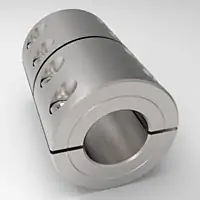
A full line of customizable flange shaft collars that incorporate an integral clamp, maintain their perpendicularity, and are easy to adjust has been introduced by Stafford Manufacturing Corp. of Wilmington, MA.
A broad line of mechanical components for use as stops, spacers, shaft connectors, and versatile mounting devices in warehouse automation systems has been introduced by Stafford Manufacturing Corp. of Wilmington, MA.
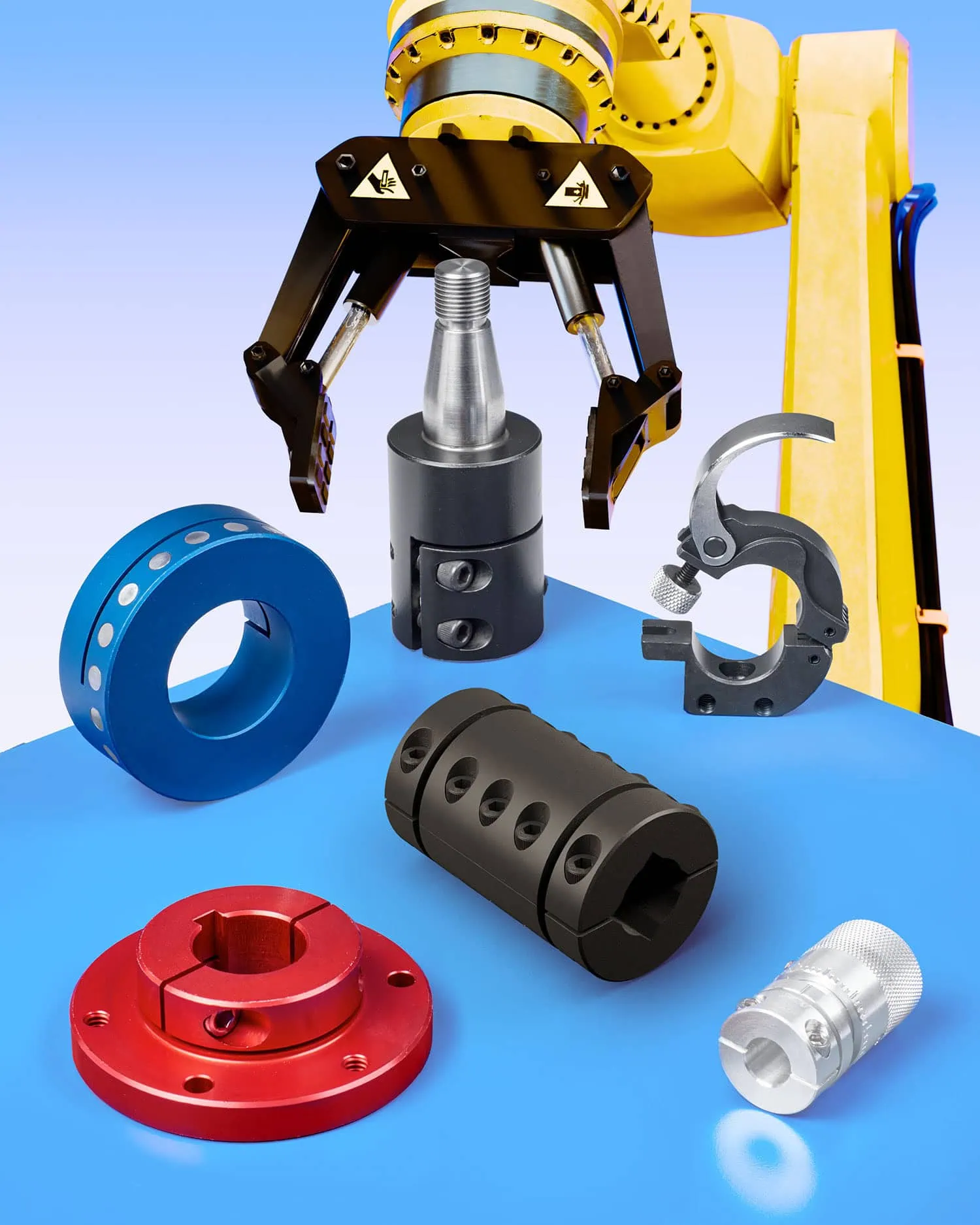
A wide range of standard and custom shaft collars, couplings, and mounting devices that are suited for use in robotic systems and equipment have been introduced by Stafford Manufacturing Corp. of Wilmington, MA.
Shaft couplings play a key role in transferring power or torque for motors, pumps, compressors, conveyors, turbines, and other mechanical equipment. Rigid shaft couplings can achieve this goal and allow for different types of shaft connections. Stepped couplings can be used for connecting different size shafts. Shaft adapters can solve compatibility issues, such as changes in shaft size or length. Inch-to-metric couplings can solve incompatibilities occurring when mating an English shaft to a metric one. Custom shaft couplings and adapters can accommodate unusual variations or configurations not satisfied by standard products.
Stafford Manufacturing produces shaft collars, rigid shaft couplings, and specialty mechanical products for motion control, power transmission, automation, and other MRO and OEM applications. Here we’ll discuss how to connect shafts, including those with different sizes, measurement systems, and other specifications.
Click to Expand
What If I Have Two Different Sized Shafts?
Connecting shafts of different sizes is a common issue that can be solved with compatible rigid shaft couplings. Designed for perfectly aligned shafts, rigid shaft couplings mate shafts with identical or different diameters while maintaining high torque transfer and preventing backlash. Many configurations of our shaft couplings have stepped bores to connect shafts that differ in size. We offer standard and custom versions of these types of rigid shaft couplings:
Two-Piece Split Clamp Couplings: easy installation and adjustment, with or without keyways, suitable when access to both shaft ends is not possible.
Three-Piece Split Clamp Couplings: easy installation and adjustment, smooth bores prevent shaft damage. One shaft can remain in place while the other is changed out or adjusted.
A close tolerance fit is a necessity whenever you are putting the coupling on a precision machined shaft. Precision sleeve couplings are uniquely suited for applications requiring extremely precise machined shaft alignment and a close tolerance shaft-to-coupling fit.
Stafford’s exclusive Precision Sleeve Coupling features a solid center section that provides a close tolerance fit on ground shafting, includes a keyway, and the Accu-Clamp™ design which incorporates integral self-centering clamping collars at both ends. This product assures shaft alignment with zero backlash. To assure precise shaft alignment, it maintains <.001″ TIR concentricity while in use. It is precision machined, non-marring, easy to adjust, with high clamping power.
Stafford offers the following types of Precision Sleeve Couplings:
What If I’m Connecting an Inch Shaft to a Metric Shaft?
Inch-metric conversion couplings have a bore on one side measured in inches and the other side in a metric size. Stafford Manufacturing carries a full range of common sizes in our selection of inch-metric conversion couplings. External dimensions and screws are in inches. These couplings can be further modified to include keyways if needed.
Our inch-metric conversion couplings can mate inch and metric shafts with zero backlash and smooth bores, which protect the shafts from damage. They have superior torque capacity compared to set screw type couplings.
Stafford offers the following types of inch-metric conversion couplings:
While shaft couplings can connect shafts of different diameters, shaft adapters enable connections when:
One or both shafts are not long enough to be effectively connected with a coupling
Shafts differ in diameter and a coupling does not accommodate the difference
Shaft damage would result in a poor transfer of power or motion
Shaft replacement is not recommended due to cost or other considerations
Available in step-up or step-down configurations, shaft adapters act as both an extension to an existing shaft and as a way to increase or decrease shaft diameter using a straight-bore or standard stepped-bore coupling. Our rigid shaft adapters use a clamp-style attachment to avoid shaft damage and come in keyed and keyless styles.
Click to Expand
None of These Work for Me — What Do I Do?
Uncommon sizes or combinations of shaft diameters, shapes, keyways, or other configurations can be solved with custom shaft couplings or adapters, avoiding the need for complete shaft replacement or system reconfiguration. Customers can custom-design couplings through our rigid shaft coupling configurator tool, which can provide product recommendations based on your specifications.
Becausemanufacturing custom parts is our specialty, our expert team welcomes requests for customized rigid couplings to meet your precise requirements. Custom modifications we commonly make include:
Bores: adjustments for special diameters, keyways, and threadings
Holding Power: adjustments for extra heavy-duty operation
Circumferential Keyways: to control axial shift
Shaft Shapes: to connect different shaped shafts
Balancing: to minimize misalignment, vibration, and wear
Materials & Finishes: meeting customer material or surface finishing requirements
Shaft Extenders: to accommodate length, duty, configuration, or other needs
Customers may also modify our fully machinable Shaft Adapter Max to meet their specific needs. It is available with keyways or without, offering multiple configurations to easily extend and adapt for hex, square, or threaded shafts.
Custom Fabrication by Stafford Manufacturing
At Stafford Manufacturing, we pride ourselves on our wide range of standard shaft couplings, collars, adapters, and related products. Our innovative designs, extensive catalog of stock components, and customization capabilities illustrate our commitment to industry-leading components and customer service.Contact us to learn more about our standard and custom components for power transmission, motion control, automation, and related applications, orrequest a quote for your next project.
Mixers are common industrial devices that consist of a motor and a propeller or paddle with a coupling acting as the connection point. Mixers are flexible, adaptable pieces of equipment found in a range of industries, from food processing to mining to chemical facilities.
Choosing the correct coupling for a mixer can be challenging as it needs to have an exact, rigid fit . This blog will highlight how to determine the right coupling for your mixer and how our configurator tool can help you configure your rigid coupling to your needs.
What Is a Rigid Coupling?
Unlike flexible couplings, a rigid coupling does not allow any radial or axial motion between the driving shaft and the driven unit. It is primarily used for vertical applications. Rigid coupling types include:
One-piece split couplings when there is access to both the motor shaft end and the paddle attachment.
Two-piece split couplings for easy assembly when in-line installation is needed.
Three-piece split couplings when the end of the shaft will remain fixed while the other is moved or changed (very common for mixer situations when paddles would be changed or replaced).
Flanged couplings when mounting options are needed.
On mixers, the motor is bearing-supported, but the shaft on the impeller side is not. Using a flexible coupling would require close bearing support on the paddle, but the sleeve-like design of rigid couplings eliminates the need for a bearing to support the paddle. This makes rigid couplings the only viable option for mixers.
Rigid couplings have a simple and durable design, allowing greater transmission of power to mixers. They are more cost-effective than other options and offer more design flexibility. While requiring exact alignment between shafts, rigid couplings offer a stronger connection, higher torque, and more precision than flexible couplings.
Advantages of Rigid Couplings for Mixers
Rigid couplings provide advantages, such as:
Excellent Torque Transmission: They can transfer torque efficiently between connected shafts.
Low Production Costs: Manufacturers such as Stafford Manufacturing can produce custom and standard rigid couplings at affordable prices.
Torsional Stiffness: Its high torsional stiffness enables better positioning.
High Precision: Rigid couplings offer high precision with almost no windup or backlash.
Alignment Capabilities: They can establish shaft alignment between the connected parts and the motor.
Easy Assembly: Rigid couplings have a simple design, allowing for easy assembly, disassembly, and maintenance operations throughout the coupling’s lifespan.
Considerations for Selecting a Rigid Coupling for a Mixer
Choosing the best coupling for a mixer requires precision. Stafford Manufacturing’s configurator tool can help you customize a rigid coupling that suits your exact needs. Configure it by bore diameter, coupling style, coupling material, screw material, finish, and other options available upon request.
Here are more details about the top considerations for choosing a rigid coupling for a mixer.
Bore Diameter
Bore diameter ranges from ¼” to 4”. Choosing the right diameter is key to ensuring a precise alignment.
Coupling Style
Coupling styles include one-piece, two-piece, and three-piece. One-piece styles have high torque capacities, unlike set screw type couplings. Two-piece styles allow for easy assembly and adjustment. Three-piece styles are used to maintain one shaft’s positioning while the other is adjusted.
Material Selection
Material selection is based on the substance your coupling is exposed to. Coupling materials include brass, 303 and 304 stainless steel, weldable steel, carbon steel, and 2024 aluminum.
How to Choose the Best Coupling for a Mixer
Consider these factors when deciding on the best coupling for your mixer:
Shaft size
Keyway size if needed
Required torque capacity
Bore diameter
Material requirements for specialized (i.e. food-grade) applications
Stafford’s rigid couplings meet these criteria as they are designed with end users’ needs in mind. Our rigid couplings come in different types, from the common one-piece split clamp coupling to precision sleeve couplings.
Choose Stafford as Your Coupling Manufacturer
Stafford is the leading manufacturer of high-quality shaft couplings and rigid couplings. With the help of ourconfigurator tool, you can determine the right rigid coupling for your needs.Contact us to learn more orrequest a quote for our products.
Stafford Manufacturing Corporation is a leading manufacturer and distributor of a variety of shaft collars, specialty mechanical components, and rigid shaft couplings for use in many types of applications. At Stafford Manufacturing Corp., we offer a wide range of rigid couplings to allow two shafts to function as one.
When deciding on the right coupling for your application, one key factor will be whether you need a one-piece, two-piece or three-piece coupling. One-piece clamp couplings offer zero backlash and feature high torsional holding power with no damage to the shafts. Two-piece couplings feature the same advantages, with the added benefit of allowing in-place service. Three-piece couplings allow you to keep one shaft in place while the other is changed.
In this guide, we’ll detail the steps for proper shaft coupling installation for the main types of rigid couplings, along with some factors that determine which couplings to use.
Materials
Based on an application’s specific requirements, rigid shaft couplings can consist of a vast array of materials, including 303, 316, and 304 stainless steel, 2024 aluminum, carbon steel or black oxide-finished carbon steel, or brass. The installation steps for rigid couplings will differ depending on the coupling type (one, two or three-piece).
Installation of a One-Piece Rigid Coupling
The steps for installing a one-piece rigid coupling are as follows.
Alignment
Rigid couplings are used when an application requires coupling of two aligned shafts (they can be shafts of the same sizes or different sizes). High stress could result if axial or radial misalignment takes place, potentially causing failure so they are only to be used with unsupported or fully aligned shafts. Once connected to two shafts, rigid couplings will prevent any relative motion from occurring. One-piece rigid couplings ensure alignment.
Installation Process
When installing a one-piece rigid coupling, take these steps:
Wipe any excess dirt or oil off the shaft as well as the bore of the coupling.
Slide one end of the coupling over its mating shaft until that shaft is 1/32” short of the cross slot
Adjust the center screw to half of the recommended seating torque.
Adjust the outer screw to half of the recommended seating torque.
Slide the other shaft into the remaining end of the coupling until it is 1/32” short of the cross slot.
Adjust the center screw to half of the recommended seating torque
Adjust the outer screw to half of the recommended seating torque
Use a torque wrench to fully adjust all screws to the recommended seating torque, going from the center screws to the outer screws.
If possible, slowly rotate shafts to ensure proper alignment.
Installation of a Two-Piece Rigid Coupling
The steps for installing a two-piece rigid coupling are:
Alignment
Like one-piece rigid couplings, two-piece couplings are used to join two aligned shafts. The use of a two-piece coupling allows installation while both shafts remain in place.
Installation Process
The steps for installing a two-piece rigid coupling are:
Wipe any dirt or excess oil off shafts and coupling bore.
Assemble the top and bottom halves of the coupling over the two shafts, making sure that the ends with the face groove are together.
Assemble the two-piece coupling to the point where there is mild resistance in the screws.
Use a torque wrench to adjust the center screws to half of the recommended seating torque.
Use the same wrench to adjust the outer screws to half of the recommended seating torque.
Use the torque wrench to adjust all screws until they’re at the full recommended seating torque, starting with the center screws and completing the process with the outer screws.
Ensure the clamping is even by checking that the slot gap is the same on both sides
If possible, slowly rotate shafts to ensure proper alignment.
Installation of a Three-Piece Rigid Coupling
The steps for installing a three-piece rigid coupling are:
Alignment
Designed for aligned shafts, the three-piece clamp coupling makes two shafts function as one. It can remain fixed to one shaft while the other is moved or changed, or come completely apart to allow the most convenient assembly and adjustment.
Installation Process
The following are the steps for installing a three-piece rigid coupling:
Wipe any dirt or excess oil off shafts and coupling bore.
Assemble the ends of the coupling with the matching face groove onto its mating shaft
3.Use a torque wrench to adjust the center screws to half of the recommended seating torque.
Use the same wrench to adjust the outer screws to half of the recommended seating torque.
Mate the other shaft with the open end of the coupling and loosely assemble the coupling top, making sure that the machined end is towards the outside..
Use the torque wrench to adjust the center screws to half the recommended seating torque
Use the same wrench to adjust the outer screws to half the recommended seating torque.
Use the torque wrench to adjust all screws until they’re at the full recommended seating torque, starting with the center screws and completing the process with the outer screws.
Ensure the clamping is even by checking the saw slot gap.
If possible, slowly rotate shafts to ensure proper alignment.
High-Quality Rigid Shaft Couplings from Stafford Manufacturing Corporation
If your application requires rigid couplings, please check out our wide variety of couplings, precision couplings, and shaft adaptors at www.staffordmfg.com. Applications include motion control, power transmission, automation, and other types of MRO and OEM applications for consumer or industrial products.
To find out more about our products and custom capabilities, contact us today with any questions or request a quote for our products.
Rigid shaft couplings connect two separate shafts by clamping onto their adjacent faces. When installed properly, the shaft coupling connects the shafts in a precise line that transfers rotary motion between the shafts without causing misalignment or breakage. However, there are two main obstacles to the perfect transfer of rotary motion:
This occurs when the application of torque results in greater shaft rotation at one end compared to the other.
Backlash is the unwanted reactive motion between connected mechanical parts that can break couplings or cause mechanical stress.
This blog explores the causes and effects of windup and backlash in shaft couplings.
What Is Torsional Rigidity in Shaft Couplings?
Windup, otherwise known as torsional deflection, occurs when torque is applied and the rotation of one end of the shaft is greater than the other end. This creates unequal torsional deflection that engineers have to consider as they set up feedback mechanisms. The varying load on the gears causes unequal wear. Torsional rigidity can also put stress on the coupling, leading to deformation, breakage, and a more frequent need for parts replacement.
What Is Backlash in Shaft Couplings?
Backlash occurs whenever mating parts in a system aren’t precisely aligned. In shaft coupling systems, the coupling may have a poor grip on each of the shafts, resulting in slight angles and unequal wear and stress on the system.
Shaft couplings can accommodate some degree of backlash, but it’s important to ensure that any backlash is well within the system’s threshold. For example, angular movements greater than 2° past the preferred angle are considered excessive backlash, and this can cause extreme wear, stress, and even breakage. Although not all backlash is bad, when the backlash is too great, it will result in erratic dial indicator and laser alignment readings. Operators should always reduce the backlash to within the 2° threshold before alignment begins.
There are different types of misalignment based on the resulting misalignment angle. These include:
Angular misalignment. When the shafts of two coupled units form a wide ‘V’ or obtuse angle
Parallel misalignment. When the shafts are parallel but one is slightly higher than the other
Skewed misalignment. Involves both parallel and angular misalignment
Any type of misalignment can cause backlash on the mechanical parts. It can also reduce the overall efficiency of the rotary motion transfer. It’s important to choose the right type of coupling that can prevent misalignment in the first place. Rigid shaft couplings, along with precise installation and setup, can reduce the risk of parts slippage and skew during operation of the system.
Choose Stafford Manufacturing for Shaft Couplings and Mechanical Components
At Stafford Manufacturing, we specialize in manufacturing rigid shaft couplings and other types of specialty mechanical components for energy transfer, motion control, automation, and other systems. Our rigid shaft couplings are designed to optimize the transfer of rotary motion. Browse our selection of one-piece split clamp, two-piece split clamp, three-piece split clamp, and precision sleeve couplings, or contact our team to learn more about our capabilities and inventory.
There are two main types of couplings: rigid couplings, which connect two shafts with a solid and high-precision hold, and flexible couplings, which can be used to connect slightly misaligned shafts but which can’t provide the same level of torque transfer. While both coupling types have their advantages and disadvantages, it’s important to know which coupling to choose in a particular application.
How Do Rigid Couplings and Flexible Couplings Differ?
Ultimately, the key difference between rigid and flexible couplings is in the connection they provide. Rigid couplings provide a rigid connection; the two shafts are firmly connected, and the coupling allows for a smooth transmission of torque throughout the system. Flexible couplings create flexible connections, and the components can lose some of the torque power through the interaction. While metallic flexible couplings offer greater torque capability than other flexible couplings, some torque is still lost.
Other important differences between rigid and flexible couplings are:
Alignment Requirements: Flexible couplings can handle slightly misaligned shafts. Rigid couplings are torsionally stiff and can’t tolerate any misalignment. This applies to both shafts that are physically misaligned at rest and parts that may cause misalignment during operation due to thermal changes.
Backlash: Rigid couplings, especially newer models of aluminum rigid couplings, can significantly reduce backlash to at-zero or near-zero levels. Flexible couplings don’t offer the same protection.
Maintenance Requirements: Because rigid couplings are stiff, they do not absorb vibrations, which can lead to early wear on parts that aren’t properly aligned. Operators should routinely check rigid couplings for wear and alignment, and they should also routinely apply lubricant. Flexible couplings can handle vibration and shock without adverse wear.
Complexity: Flexible couplings often have more components and/or are more complex. This can make operation and maintenance more complicated. Rigid couplings are more simple and straightforward in comparison.
Applications: Flexible couplings can be used in servos with low or moderate torque levels and the potential for shaft misalignment. This includes applications such as machining tools, semiconductor manufacturing, and packaging equipment. Rigid couplings work best for high-torque requirements, shaft support applications, and push-pull use cases.
Cost: Rigid couplings are more affordable than flexible couplings, which tend to have a high cost.
Advantages of Rigid Couplings
Both rigid and flexible couplings have their place in almost any complex motion system. However, rigid couplings provide several advantages over their flexible alternatives that make them the preferred choice for many projects. Some of their key advantages include:
Excellent torque transmission: Rigid couplings can efficiently transfer torque from one shaft to the other connected shaft.
Low cost of production: Manufacturers can produce standard and custom rigid couplings at cost-effective rates.
Precision, with nearly zero windup and zero backlash
Torsional stiffness: High torsional stiffness allows for better positioning.
Simplicity
Alignment capabilities: Rigid couplings can be used to establish shaft alignment between the motor and connected components.
Suitability for push-pull and support applications
Easy assembly, disassembly, and maintenance operations throughout the life of the coupling
High-Quality Rigid Couplings From Stafford Manufacturing
Rigid couplings provide excellent torque, minimal backlash (with some of our standard couplings providing zero backlash), and high torsional stiffness. This makes them ideal for a wide variety of precision applications that need high levels of power. At Stafford Manufacturing, we manufacture and supply our clients with high-quality rigid couplings for a range of applications. Learn more about how to choose the right rigid coupling for your needs, or browse our catalog to find the right products today.
Choosing the correct rigid shaft coupling for your application requires thorough analysis of the application and in-depth understanding of the different coupling designs. Due to the extensive selection of couplings on the market, it can be difficult to choose the right one for the job at hand. To this end, we have compiled a list of the most common errors users make when selecting rigid coupling, and ways to avoid making the same mistakes.
Common Errors Choosing Rigid Couplings
Rigid couplings are critical to the safe and reliable operation of a variety of systems. When considering which coupling is ideal for your project, avoid these common pitfalls.
Focusing on Cost
Although cost is an important aspect when determining which rigid coupling to use for your project, the function of the coupling should be the primary consideration. While a lower initial price point may be an attractive choice, using an incorrect coupling can result in costly failures, ultimately resulting in significantly higher repair and replacement costs. Rather than selecting your coupling based on price, choose the one that will function well within the system, optimize equipment operation, and extend the service life of the component parts.
Waiting Too Long
Often, couplings take a back seat during the design process and are added as almost an afterthought once the process is mostly complete. Rather than waiting to determine which couplings to use, include couplings in the initial design process. This allows you to select couplings based on the complex needs of the system so that they enhance the design rather than detract from it. Early selection of couplings will ensure that the couplings and system components operate smoothly and efficiently, with significantly less risk of error or premature failure.
Excessive Misalignment
One of the most common causes of coupling failure is the use of incorrect couplings for the misalignment conditions present in the application. Excessive misalignment forces the couplings to bear loads that exceed their specifications, resulting in damage and coupling failure. Since flexible shaft couplings are designed to accommodate a range of misalignments with a degree of flexibility, it is important to understand the limitations of the coupling you are using.
3 Questions to Ask When Choosing the Proper Rigid Coupling
To avoid the most common mistakes in choosing rigid couplings, ask yourself the following questions:
Is a rigid coupling correct for my application? Rigid couplings are ideal for use with unsupported shafts. Supported shafts that exhibit any degree of misalignment are poorly suited for rigid couplings and can result in damage not only to the coupling but also to the shaft supports and associated component parts.
Do I need keyways? Keyways are not always necessary. They should be used for couplings that are intended to maintain radial alignment between shafts and support loads with high torque. For applications in which radial alignment and high torque are not considerations, keyways may not be required.
Why would I choose a clamp coupling rather than a (less costly) set-screw style? Although it may be tempting to choose a cheaper set-screw clamp for your application, keep in mind that clamp couplings are more versatile. One-, two-, and three-piece styles allow clamp couplings to be applied to a variety of shaft and tubing sizes and materials with a high degree of precision, thereby reducing the risk of damage and coupling failure.
At Stafford, we offer hundreds of clamp coupling designs, including a broad range of shaft size combinations, torque capabilities, component materials, and shaft shape designs. Some of the primary factors to consider when selecting the best coupling for your application include:
Shaft Shape: Determine the design of the shaft to which the coupling will be applied. Couplings are designed to operate on round, square, and hexagonal shafts, so choose the best coupling for the shaft shape.
Standard of Measurement:Clamping screws may be designated using either English or the metric system. Be sure to check that the standard of measurement for the coupling components is consistent with the system design.
Shaft Size Combination: A variety of off-the-shelf rigid couplings are available in different bore sizes, using both metric and English standards. If you are unable to locate a coupling that specifically matches your required measurements, consider re-machinable and customizable couplings for a cost-effective and efficient solution.
Durability Requirements: Although most applications will require standard strength couplings, heavy-duty couplings are available for more demanding applications.
Keyway Selection:Analyze the system to determine whether radial alignment or extra torque will factor into overall operation, and use this information to determine whether a keyway is necessary.
Stafford’s Selection of Rigid Couplings
Professional designers and engineers must take into account a variety of factors when choosing the ideal coupling for a given applications. The intended purpose, application environment, accessibility, and maintenance requirements are all important considerations. At Stafford, we pride ourselves on offering quick and affordable coupling manufacturing services from the initial design phase through the finished product. We are dedicated to swift service, and quote requests are answered within 24 hours of submission.
Our broad range of quality shaft couplings include:
Standard Rigid Shaft Couplings
Shaft Adapter Couplings
Specialty Shaft Couplings
Customizable Steel Clamp Couplings
We are also pleased to offer a range of shaft collars, specialty components and accessories, mounting components and clamps, and dedicated maintenance, repair, and retrofit services.





 Advantages of Rigid Couplings for Mixers